
William D. Sill (no apparent relation to Sterling W. Sill) had a very interesting life, but is very little known to the general public. I draw the summary below from his donated papers, journal, and obituary, some of which I discovered with a research grant from the Church. (Notably, as is often the case in history, there are little inconsistencies in dating, titles, etc.)
Born in 1937, Sill graduated high school in Las Vegas (1955), and served a mission in Argentina (1958-61), where he met his future wife Nelida Salinas. He returned home to BYU, married Nelida (aka “Nelly”), graduated in Geology (1963) and then received MS/PhD degrees in geology and paleontology from Harvard while driving a cab at night to earn money. He worked as an associate professor at Yale (1968-70), before moving back to Argentina where he worked as a professor and 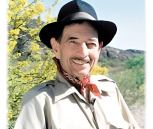 field paleontologist for the National University of San Juan. Sill contributed significantly to establishing a UNESCO world heritage site known as “Valley of the Moon” or more officially, Ischigualasto Provincial Park. (This is located in the Atacama Desert, a geographical reference more of us may have heard of.) His research there focused on early Triassic dinosaurs, and Ischigualasto left such an impact on his soul that he asked to be buried there. As he was the “father” of the park, he ultimately was. Here’s an article in Spanish about him and his son, working there, with lots of pictures.
Beginning in Argentina, Sill taught and worked in dual capacities: academic work at a University and Institute Director. When political unrest catalyzed a move to Texas c.1979, Sill taught Geology at the University of Texas as a Senior Lecturer while directing the LDS Institute attached to UT-Austin. He then moved to Norman, Oklahoma as the LDS Institute Director (89-92), but worked as editor for the Vertebrate Paleontology Bulletin and a Research Associate for the

Sill helped bring a moon rock to the Oklahoma museum. Cropped out is a police guard required at all times for the rock.
Oklahoma Museum of Natural History. Though deeply committed to Church service and teaching, he also authored seventeen articles in scientific journals and co-published a geology textbook.
His callings were in a Bishopric in Argentina, and as Bishop from 1979 onwards in Austin. While the Director there (1978-1989), he took Hebrew classes at the Jewish Center across the street from the Institute. He then retired and went back to Argentina but “continued teaching for two years at the Mendoza Institute, and gave lectures all over at CES-sponsored events.” Sill wrote that his “personal standard of preparation [for teaching Institute] was a minimum of 10 hours of research and spiritual preparation for every hour of class time.”
Moreover, according to his obituary, “a staunch Republican, [Sill] marched with Dr. King to the Washington Monument, admired Jimmy Carter for his compassion and helped left-wing political sympathizers escape persecution in Argentina by escaping through Uruguay in the seventies.”
Sill’s experiences and expertise put him in contact with a number of General Authorities. While in grad school, Boyd K. Packer was the Mission President in Boston, and Sill used to go talk to him about evolution. He writes,
My studies focused much on evolutionary theory. My professors were the most prominent men in the field, Ernst Mayr, E.O. Wilson, George Gaylord Simpson, Al Romer, James Watson…. We worked with the Leakeys in Kenya and Louis was somewhat disturbed that we had made a discovery 1.5 million years older than any of his famous works.
In my personal and strongly religious point of view, I had the hope of discovering the way to end the conflict of evolutionary theory and the biblical origin of humankind. Elder Boyd Packer was the mission president at that time, with his home in Cambridge just behind the chapel. He held informal Institute classes for us once a week at the chapel. I went to him for advice on how to deal with the academics of evolution and our much stronger religious beliefs. He gave me the best advice I ever had and for years later in all my institute classes, I passed on that advice to college students. This is the counsel he gave me:
Bill, continue on with your studies and be diligent in the academics. Rmain truth and faithful to the gospel and your covenants and I promise you ten years from now you will look back at the questions you had and will say, ‘what was all the fuss about,’ whether you find answers or not it won’t really matter as long as you stay faithful.’That is exactly what has happened, the conflicts and questions at the time have faded away and are just not significant any more, even though the answers still haven’t been found.
When Sill taught at Yale, he and a grad student named Jeffrey Holland co-taught the high priests group in their ward. In Argentina, Sill “served as a translator for Elder McConkie and enjoyed his great spirit and fine scholarship.”
“While teaching Institute in Austin Texas, I developed a special advanced course on the history and philosophy of conflicts between science and religion.” It was apparently quite popular. (Looking over his notes and syllabus, it seems that he had serious gaps in his understanding, which would be normal for a well-read scientist, as opposed to historian. For example, he seems entirely unaware that the framing of “science-religion conflict” was almost entirely artificial and late. He seems to have accepted the inherited framework uncritically.) While Sill was still Director in Austin, Elder Holland went to the Institute as a visiting speaker. Sill also exchanged correspondence with Henry Eyring, “the head of CES during most of [his]. years as an Institute Director, and [they] met on various occasions.”
When he retired in 1992, after 17 years in the CES, Sill wrote two internal papers. I am not aware of who he sent these to, nor how broadly they circulated. One had the title, Reflections of a Retiring CES Teacher, or, A View of the World as Seen by an Ant Crawling on a Sofa. The other carried the anodyne title Research Report for CES on Evolutionary Theory and was apparently submitted to CES for potential “reference use” whatever that might mean. Analysis of these two will require a future post.
I suspect this is the only time a Harvard-trained geology PhD with “Yale professor” on his CV has been able to speak to CES insiders with the same kind of scientific and ecclesiastical credentials, modeling a kind of balance in the cultural perception of science and religion as two competing masters.

William D. Sill, 1937-2008
More Tales from the Archives here.
Recent Comments