
Unless you’ve been living under a rock, you’re aware of an announcement of changes to the Church Handbook about use of (and attitudes towards) non-KJV translations. I’m thrilled about this; I’ve also been on planes and deprived of sleep for the last two days, but finally had a good night’s sleep, so let’s try this while it’s still timely. Caveat: written quickly, unrevised, and under sleep deprivation.
And for anyone new here, I read daily in Greek and Hebrew, and have published on Bible translation.
Much of the conversation around translations can be sidestepped by making sure we’re all operating with the conceptual understanding, which is this:
There’s no such thing as THE Bible.
No single translation is THE Bible, and no single ancient manuscript is THE Bible. Rather, we are reading 1)English translations of 2) collected manuscripts 3) selected by scholars and historians 4) in a format no Israelite or early Christian knew.
Once we understand that, then other questions are easier to handle.
Why do Bible translations differ?
- It might depend on what manuscripts the scholars prioritized or had access to. The King James translators didn’t have access to the oldest Hebrew manuscripts, like the Dead Sea Scrolls. And sometimes just being oldest doesn’t mean the text makes the most sense. Scholars sometimes have to decide and make hard choices, and translations reflect that.
- It might depend on their religious commitments. Jewish translations don’t translate in a way to point towards Jesus. Evangelical translations (like the NIV) translate in such a way as to reflect and protect their belief in inerrancy and core Protestant beliefs about Paul and salvation.
- It might depend on their understanding of the languages. The KJV translators had no access to important cognate languages like Akkadian or Ugaritic; they had no parallels to NT Greek, and supposed it to be what Greek sounded like when you were inspired, i.e. “Holy Spirit Greek.” It’s now called Koine or Common Greek, because newer discoveries have shown that it was common, everyday Greek.
- It might depend on their understanding of the canon: Jewish translations don’t include the New Testament, for obvious reasons, and Protestant Bibles don’t include the Apocrypha. But also, if Paul or Matthew use an Old Testament scripture a certain way, how much should that affect one’s understanding of— and therefore translation of—that Old Testament passage? Scholars will differ here.
- It might depend on the translational goals and philosophy; is this a pulpit Bible for preaching, or a personal Bible for study? Is it aimed at college-level readers or sixth grade? Paul sometimes uses extremely complex and lengthy sentences; Ephesians 1:3-14 (11 verses!) is one sentence in Greek. How much does the translation goal and philosophy require “distorting” the text? As the saying goes, all translations are traitors.
All of this is to say, we shouldn’t just read one translation as THE Bible. We should read several, together, AND we should know each one’s characteristics, what philosophies and motivations underlie the translation. Don’t read any translation “blind” so to speak.
The KJV is elevated but highly archaic language, but based on poor manuscripts and 500-yr old understanding of the languages. The NIV was published in 1973/78, but is a committed Evangelical translation aimed at 7th-grade equivalency. The NRSV is a 1989 descendent of the KJV done by a variety of religious scholars, aimed at 11th grade. Robert Alter’s translation is focused on literary aspects like puns and allusions, and all single-translator versions are likely to reflect the idiosyncratic philosophies of its single translator: in this case, secular, Jewish, literary, Hebraic.
All of the above suggests further that while translational “accuracy” can be a debated question… some translations can definitely be wrong. Sometimes this is complex arguments about meaning, ambiguity, or the theology implied by the translation. Other times it’s as obvious as a printing error, such as the famous Adulterer’s Bible, which left out a “not” in Exodus 20. This resulted in God’s divine command, “thou shalt commit adultery.” Other times, it’s the meaning implied by a particular translation or arrangement.
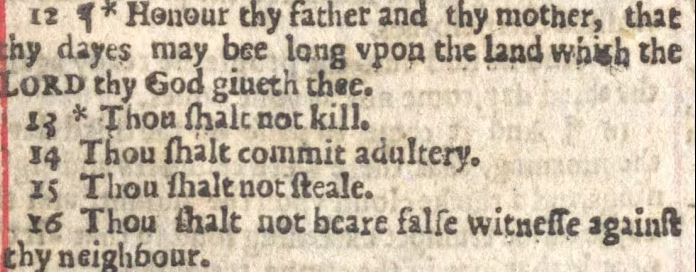
As the Church grows more globally and our English drifts more and more from a KJV that was already archaic on day 1 of its printing in 1611, a soft or de facto KJV-only only position becomes more and more problematic. Missionaries are less effective because they don’t understand it well. We read it less. And we undermine our witness when General Conference talks center on unfortunate idiosyncrasies of English language shift in the KJV which are unintelligible to anyone not using the KJV, e.g. “certain women” and “making a difference.” Dan McClellan worked for Church Translation, and has an article on “Bible Translation and the Church” which highlights the problems of the last one.
As Philip Barlow masterfully chronicled in his book (Amazon Affiliate link) and this paper, Latter-day Saints had a variety of views towards the Bible and interpretation. It’s really only mid-20th century, as part of a “fundamentalist turn,” that the KJV becomes our official Bible. This is at a time when some LDS scholars like Sidney Sperry were writing about and suggesting alternate translations, and some General Authorities were taking the view that Bibles “written in our vernacular [are] only one of the signs of the times.” Rhetoric arises about other translations having faithless translators, or downplaying the divinity of Jesus. Use of the KJV — but more significantly the rhetoric around it— solidifies.
The Church’s new handbook update, Church News, and Newsroom statements address all of these. Other translations are useful. We can and should use them to understand. Their translators are not faithless heathens. Translations are aimed at different age groups. Reading other translations generally leads to increased joy, understanding, and appreciation of the Bible. Many of us who have been doing this for a good while are not faithless.
Some of this strikes me as a cultural pronouncement as much as a policy or academic one. It’s very much in line with the other historical changes and trend to shed our inherited Protestant tendencies through careful examination (see my detailed talk here, longer version now published here). It also helps us to read scripture literally. (See post here and talk here).
So with very minor quibbles, I think this will accomplish much good in the Church, and the timing is wonderful, and I applaud it enthusiastically.
Takeaway: Be informed about and read multiple translations, including the KJV. Read them together as a family, and talk about the differences. Use them to understand and teach the Gospel.
I tend to read in Greek and Hebrew, but here my preferences are (for the Old Testament)
- the NRSV, available freely many places
- the NRSV + lengthy commentary and notes as the SBL Study Bible (Amazon affiliate link)
- Robert Alter’s literary translation and notes, Amazon Affiliate link
- the Jewish Publication Society translation aka JPS (1985)
- the JPS+ lengthy commentary and notes as the Jewish Study Bible
- the first edition is a free PDF here, or $ in Logos here.
- Second edition from Amazon.
- the JPS+ lengthy commentary and notes as the Jewish Study Bible
Many more suggested resources previously on my blog and listed without commentary here.
Happy reading
December 17, 2025 at 5:28 pm
Find this overwhelming
December 20, 2025 at 1:26 am
Two easy options: 1) Download the Parallels Plus app (free, approved by the Church), and set up a parallel KJV/NRSV.
2) Buy a paper SBL Study Bible.
I have some further posts about practical application
December 17, 2025 at 9:43 pm
I can’t say how happy this has made me. I mean, I wish it had been shouted from the Conference Center pulpit, but this will do!