A candle inside the Holy Sepulcher
These two chapters are loaded. First, we encounter the third member of the Unholy Trinity of antichrists in the Book of Mormon. First was Sherem (Jacob 7), then Nehor (Alma 1), now Korihor. Continue reading
Historian of Religion, Science, and Biblical Interpretation

A candle inside the Holy Sepulcher
These two chapters are loaded. First, we encounter the third member of the Unholy Trinity of antichrists in the Book of Mormon. First was Sherem (Jacob 7), then Nehor (Alma 1), now Korihor. Continue reading

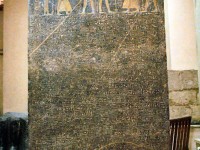
An example of Egyptian history-writing, the Merneptah stele. Public domain.
Historiography is the study of how history is written. For many people today, history has become journalistic, a simple retelling of “the facts about the past,” but history and history-writing is, in fact, far more complex than that. (See here for some Ensign articles on it.) Continue reading
These chapters are the violent dénoument of the Ammonihah story. Grant Hardy cogently points out how this story with Alma/Amulek parallels an earlier story with Abinadi. Continue reading

My picture, from the Kidron Valley.
Once again, the lesson and chapter divisions cut across the 1830/original chapter divisions, breaking up logical units. In particular, today’s chapter 12 extended into chapter 13:9, where it terminates appropriately with an “amen.” Then a new section began in 13:10-15:19. It is after 13:10 that Alma transitions into speaking about Melchizedek and high priests, which I shall take up next week. (Teaser: I think Alma’s invocation of high priests is a direct response to the objection that the tree of life is blocked by cherubim and a flaming sword.) Continue reading

Good Shepherd. Public domain, from wikipedia.
Alma has divested himself of the judgeship to go on a mission of sorts, to his own people, and stir them up in the ways of remembrance. These three chapters were also individual units in the 1830, so let’s look at what they contain. Continue reading
I’ve written a bit about Henry Eyring before (here in connection with General Conference and creationism, and here on Church authority and argument.) He’s a central figure for talking about 20th century science-and-religion arguments in the Church, which you can read about in his Faith of a Scientist, his biography Mormon Scientist: The Life and Faith of Henry Eyring, and this article from The Search for Harmony called “Agreeing to Disagree: Henry Eyring and Joseph Fielding Smith.” Continue reading
Today we move into the Book of Alma.
The stories of Alma Sr. and Alma Jr. are a major focus of the Book of Mormon; If we start in Mosiah 17, where Alma first appears, and count through the end of the Book of Alma, it’s roughly 40% of the entire Book of Mormon, by wordcount. (I generated this using Bibleworks 10, though it is off by a bit, because my electronic text doesn’t include original chapter or book headings. Total Book of Mormon count is roughly 267,000 and Mosiah 17-Alma is roughly 99,400.)
Why did Mormon choose to spend so much time on the period of the Almas, and so little on, say, 4th Nephi? Is it source dependant? (Mormon can’t write what he doesn’t have sources for.) Is it something about the material that Mormon found particularly useful or relevant?

My picture, from the Kidron Valley.
This lesson has us jump to Alma’s retelling of his experience being unconscious for three days, in Alma 36. The story of Alma the Younger is actually told in three places, not just two: Mosiah 27:8-37 (roughly contemporary), Alma 36 (Alma jr. recounting to his son Helaman), and Alma 38:6-8 (Alma Jr. recounting to his son Shiblon.) Continue reading

Red brick store in Nauvoo, where the first endowments were done on May 4, 1842.
Edit: I’ve added this syllabus to the main menu at left, and simplified the url for easy access, to http://BenSpackman.com/syllabus
May 4th holds significance in LDS history: it’s the day Joseph Smith introduced temple ordinances in the upper room of the red brick store in 1842. The temple ties together a number of questions, like: Continue reading
Melvin Cook, famous chemist and ardent LDS young-earth creationist, thought scripture should be interpreted literally.
My analysis is intended to be strictly literalistic; in my view, intellectual honesty requires literalism in the interpretation of the scriptures.
President Joseph Fielding Smith also made repeated statements about the necessity of reading scripture literally.
I agree with them. But I’ll go one better and do something they never did: I’m going to define the term “literal.” Continue reading
Recent Comments