Today’s text includes a good bit of carry-over from the war chapters, while adding political intrigue and plots. Continue reading
Historian of Religion, Science, and Biblical Interpretation
Today’s text includes a good bit of carry-over from the war chapters, while adding political intrigue and plots. Continue reading
These chapters (beginning in 39) are all focused on Corianton, who gets quite the paternal talk. Assuming that these chapters aren’t using Corianton merely as a framework to talk doctrine (i.e. why would this all be recorded, or is Mormon expanding it?), we can guess that Corianton hadn’t understood some things, such as the resurrection, justice, mercy, atonement. And granted, it’s not as if these are basic arithmetic, easily graspable.
What do we know about Corianton? Continue reading
The Book of Mormon has a variable pace. Occasionally, we skip through decades or even hundreds of years on a single page. Other times, like today, Mormon’s editing moves us into super slow motion, relatively speaking. What is probably only a few hours in real time for Alma to speak to his sons occupies six full chapters, which we slow down further by breaking it up into two weeks of study. (This will be significant for understanding Alma 43 onwards, and I’ll comment further there.)
I open today with the structure of the text we’re covering. Alma 30-34 are really one unit, which we break up. In the 1830 Book of Mormon, they constitute one chapter, Alma XVI. Presumably, we’re breaking these up because of their doctrinal nature; we want to slow down and spend time on them.
Today we cover Alma 32-34, which looks like thisin the rough big-picture outline.
32– Alma continues preaching at Antionum; “faith sermon” on the hill Onidah.
33– Crowd’s negative response; Alma continues his sermon.
34– Amulek takes over, and preaches to the crowd on the hill.

A candle inside the Holy Sepulcher
These two chapters are loaded. First, we encounter the third member of the Unholy Trinity of antichrists in the Book of Mormon. First was Sherem (Jacob 7), then Nehor (Alma 1), now Korihor. Continue reading

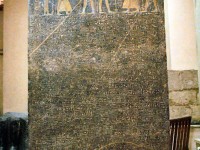
An example of Egyptian history-writing, the Merneptah stele. Public domain.
Historiography is the study of how history is written. For many people today, history has become journalistic, a simple retelling of “the facts about the past,” but history and history-writing is, in fact, far more complex than that. (See here for some Ensign articles on it.) Continue reading
These chapters are the violent dénoument of the Ammonihah story. Grant Hardy cogently points out how this story with Alma/Amulek parallels an earlier story with Abinadi. Continue reading

My picture, from the Kidron Valley.
Once again, the lesson and chapter divisions cut across the 1830/original chapter divisions, breaking up logical units. In particular, today’s chapter 12 extended into chapter 13:9, where it terminates appropriately with an “amen.” Then a new section began in 13:10-15:19. It is after 13:10 that Alma transitions into speaking about Melchizedek and high priests, which I shall take up next week. (Teaser: I think Alma’s invocation of high priests is a direct response to the objection that the tree of life is blocked by cherubim and a flaming sword.) Continue reading

Good Shepherd. Public domain, from wikipedia.
Alma has divested himself of the judgeship to go on a mission of sorts, to his own people, and stir them up in the ways of remembrance. These three chapters were also individual units in the 1830, so let’s look at what they contain. Continue reading
Today we move into the Book of Alma.
The stories of Alma Sr. and Alma Jr. are a major focus of the Book of Mormon; If we start in Mosiah 17, where Alma first appears, and count through the end of the Book of Alma, it’s roughly 40% of the entire Book of Mormon, by wordcount. (I generated this using Bibleworks 10, though it is off by a bit, because my electronic text doesn’t include original chapter or book headings. Total Book of Mormon count is roughly 267,000 and Mosiah 17-Alma is roughly 99,400.)
Why did Mormon choose to spend so much time on the period of the Almas, and so little on, say, 4th Nephi? Is it source dependant? (Mormon can’t write what he doesn’t have sources for.) Is it something about the material that Mormon found particularly useful or relevant?
Recent Comments